This section will cover the rolling stock of the Interstate Railroad. In the early years, this railroad had coal hoppers, gondolas, boxcars, flat cars, caboose and passenger equipment. There is not much information available on the passenger equipment or the boxcars. The boxcars and flats that survived into the later years were used as MOW equipment. I will be covering the coal hoppers, MOW equipment and caboose rosters. The color reference for the cars can be found on the right side of this screen.
Business Car
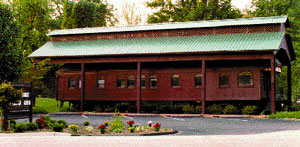
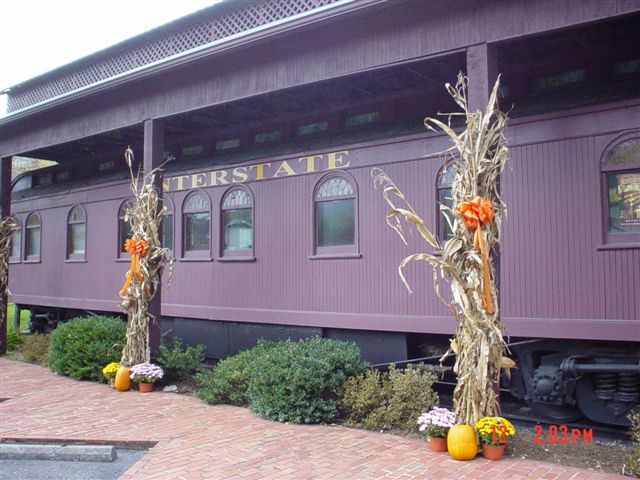
The Interstate Business car was used by the officers of the railroad, for trips and visits to other railroads. The car was retired from off property trips due to new rules, stating that the railroad had to pay for 30 round trip tickets for each trip. The car was offered up for sale in the 50's, without any takers. It sat in the car shed for a number of years until it was donated to a local coal company, to be used as a fishing lounge. The car had a open observation deck. The interior had an observation room, 2 staterooms, a dining area, a kitchen and porter facilities. The observation room had a speedometer in the rear of the room. The car was maroon red with a black roof. The lettering was gold. Today, the car sits in Big Stone Gap, Va.. It houses the Lonesome Pine Tourist Information Center.
Coal Hoppers
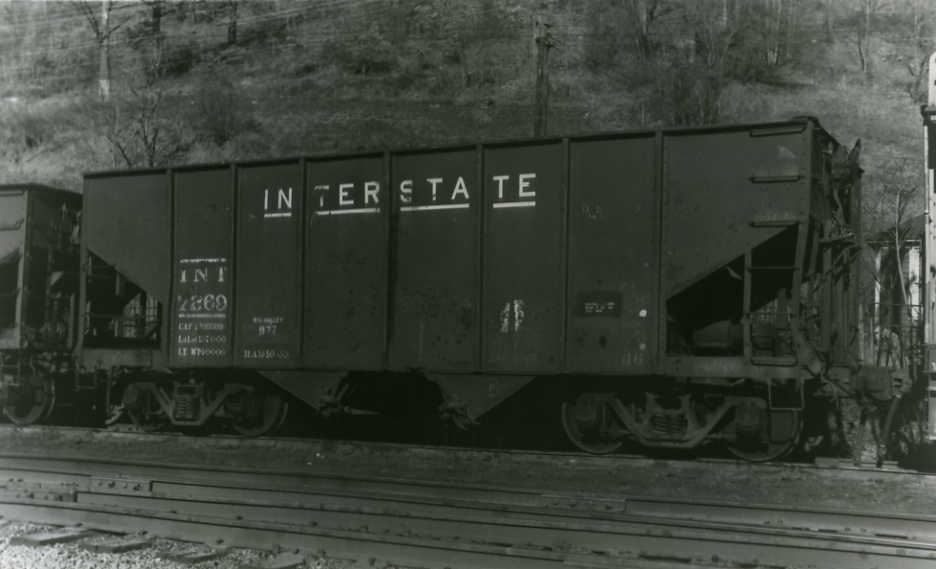
50 and 55 ton hoppers were the norm on the Interstate 1920's to the 1960's. At one time, the road hit a high of 3147 hoppers. The number of hoppers in service at one time goes up and down. The fleet lasted until the last was retired in 1983. The Interstate was buying new hoppers up until the early 1950's. In 1958, 729 were acquired from the New River Consolidated Coal and Coke Company (NRBX), a subsidiary of Berwind-White Coal Mining Company. They were numbered 15500 - 16235. This group of cars were a GLa hopper, a Penn.RR design.
Interstate numbered their 50-55 ton steel hoppers from 1100 to 16236. This number represents renumbered hoppers after they were rebuilt, as well as new purchases.
The lettering on the hoppers was changed sometime during the rebuilding program in the 1940's. It went from a fancy font to a block style.
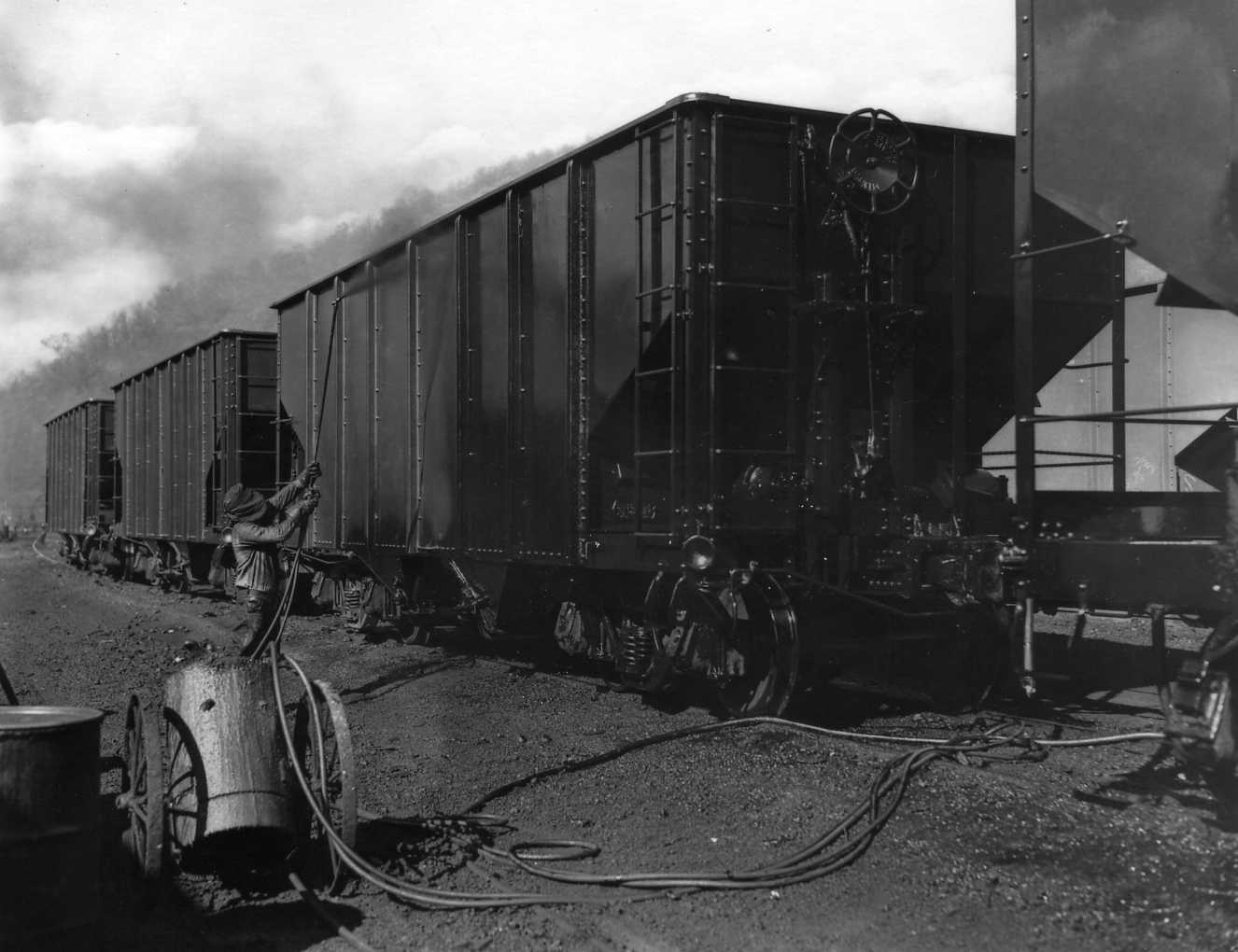
All the Interstate hoppers were ribbed sided with white lettering on a black body. After the Southern takeover, a few offset side hoppers with side extensions were painted an oxide red color and lettered Interstate, using a Southern-inspired lettering scheme. Some of the ribbed side hoppers also received the same type lettering.
Posted to the SMRF list by Dan Bourque.
You can visit Dan's site by clicking here:
Modeling the Interstate's hopper fleet is actually pretty simple. All
of the hoppers ordered by the Interstate from 1923 on were of a 50 or 55
ton, rib-side twin design. The Accurail USRA hopper is a pretty good HO
scale stand-in for several of the classes which were roster-ed from
1923-1970. For you N-scalers, I think Micro Trains (?) makes a similar
car. The second twin design was slightly taller and had more closely
spaced bay doors. I've studied pictures, and I think an MDC 3-bay with
the center removed would capture the proportions nicely. Modeling a few
of these along with the USRA style hoppers would really make your train
look authentic.
The Accurail hopper already comes in Interstate colors (black with
white lettering). This is a great starting point because the paint is good
quality and the black is easy to match. If you want to paint it
yourself, Campbell Road makes dry transfers (they may even make N-scale
transfers). To make the first variant, build the Accurail kit as-is but
remove the four small angular gussets in-between the slope sheets and
side-sill on the sides of the car. This will make a car that fits at
least the 5510-7009 series. A second style of hopper can be made by
building the kit per directions but replacing the brake lever with a
brake wheel (parallel to the car ends, not the rails). This hopper
matches the 15000-15321 cars rebuilt by the Interstate's Andover shops in
the 50s. The MDC kit-bash would represent the 8010-9120 cars.
The Interstate also had on the roster some ex-Southern cars including some
offset-side, extended-height cars acquired in 1965 after the Southern
buyout. These cars were red with a Southern-style jumbo "INTERSTATE" on
the side. These cars were the 9200-9234 class. Many of the 8010-9120
cars were also repainted in this scheme beginning in the early 60s--all
but the big "A" can be pieced from the "SOUTHERN" on Micro-scale's decal
sheet. Beginning with the Southern merger in 1960, most of the
Interstate cars were slowly phased-out of regular service and used as
shuttle cars between the mines and trans-loading facilities at
Appalachia and Wentz. They were gradually replaced by 70 ton hoppers
beginning in the mid-70s, but some hung on until after the NS merger!
I don't have pictures of the other classes in the roster, so I can't
tell you what's a good match for every series, but here's the all-time
Interstate hopper roster.
Class Type Years of Service
100-134 40 ton-wood 1914-1929
1000-1019 40 ton 1912-1934
1100-1750 55 ton 1925-1929
2000-2299 50 ton 1913-1951
2300-2799 50 ton 1918-1951
2800-2809 50 ton 1922-1934
5000-5509 55 ton 1920-1951
5510-7009 55 ton 1923-1956
7010-8009 50 ton 1946-1983
8010-8261 50 ton 1948-1983
8262-8761 50 ton 1948-1983
8762-8891 50 ton 1949-1983
8862-8911 50 ton 1951-1983
8912-9120 50 ton 1952-1983
9200-9234 55 ton 1965-1973
9300-9323 50 ton 1965-1971
9400-9718 50 ton 1965-1973
15001-15100 55 ton 1924-1929
15101-15878 55 ton 1924-1929
15000-15321 50 ton 1956-1967 (rebuilt)
15500-16236 50 ton 1957-1970 (rebuilt)
Enjoy!
Dan Bourque (INTERSTATE RR, HO)
M.O.W. Cars
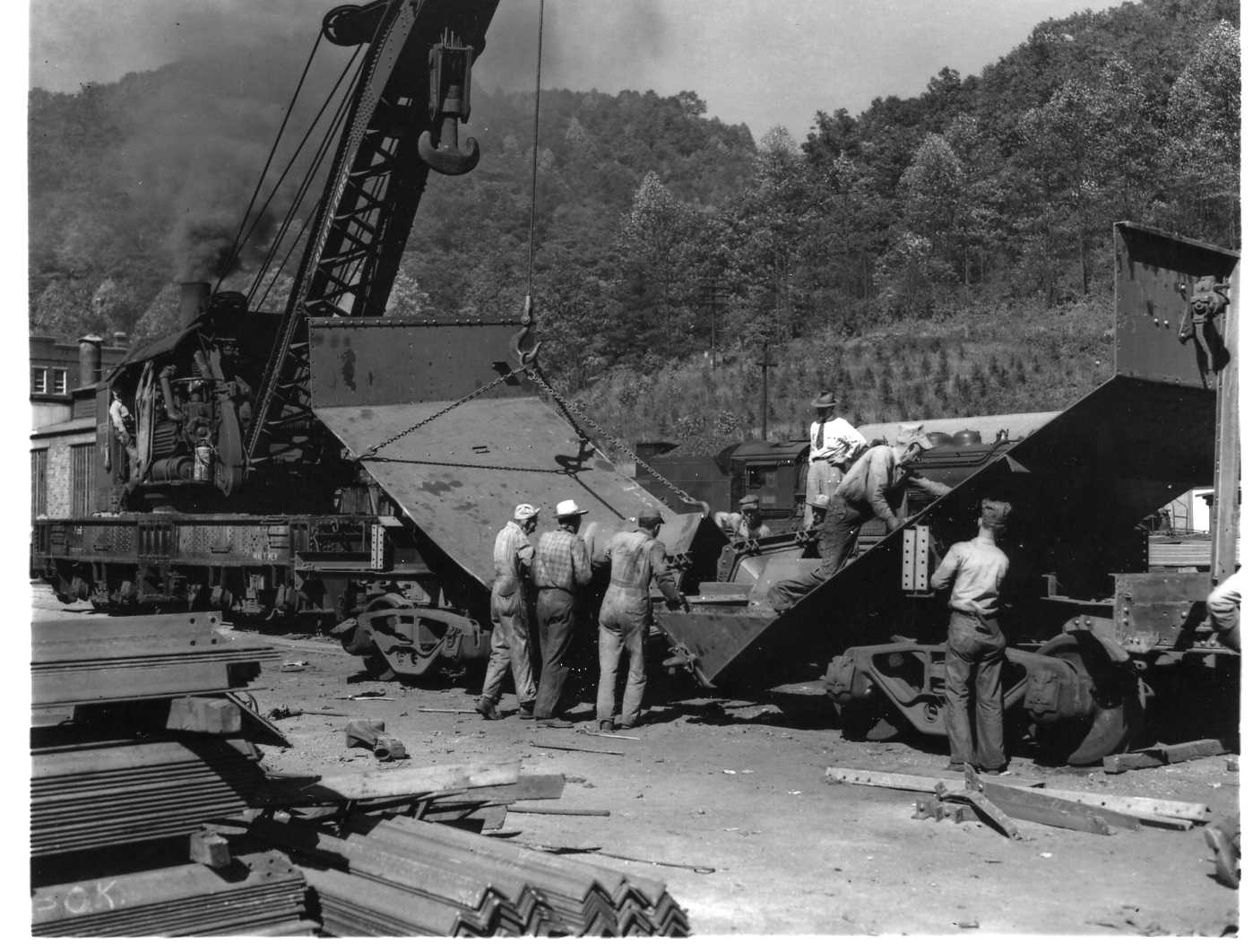
Maintenance of way equipment consisted of old flat cars and boxcars, that were removed from revenue service. The equipment cars and crew cars were made from old outside brace boxcars. This equipment stayed on the companies line and wasn't allowed off the property, due to the age of the equipment and were not upgrade for revenue service. At the time of the Southern takeover all the MOW equipment were riding on arch-bar trucks, which were outlawed at that time. Before Southern could use any of the equipment, they had to update them and replace the trucks.
The crane was numbered W-51 and it was steam powered. It stayed that way until well into the Southern years.
The colors for the equipment were as follows: Crane - all black with white lettering. Crane tender - all black with white lettering. Tool car - Mineral red with white lettering.
Caboose
The Interstate Railroad had a total of 19 caboose during the life of the railroad. All had wooden sides. They started out with vertical siding and most, that were still on the roster during the 1960's, were rebuild with marine board sheathed sides. Six of the early cabs were "bobbers"(4 wheeled). The Interstate cabooses kept their original road name on their sides until they were retired in 1973.
Bobber caboose roster
A1.....Acquired in 1914, retired in 1922.
A2.....Acquired in 1918, retired in 1923.
A3.....Acquired in 1918, retired in 1927.
A4.....Built 1903, Acquired in 1920, retired in 1956.
A5.....Acquired in 1922, retired in 1927.
A6.....Acquired in 1922, retired in 1927.
**note** A4 was built has N&W #17182, it was purchased in 1920 and was the only "bobber" to make to the diesel years. During the Diesel years, it was used on the Stonega Crew due to the tight clearances in the coke yard at Stonega.
The rest of the caboose fleet
9......Built 1942 for the Int. RR, retired in 1947.
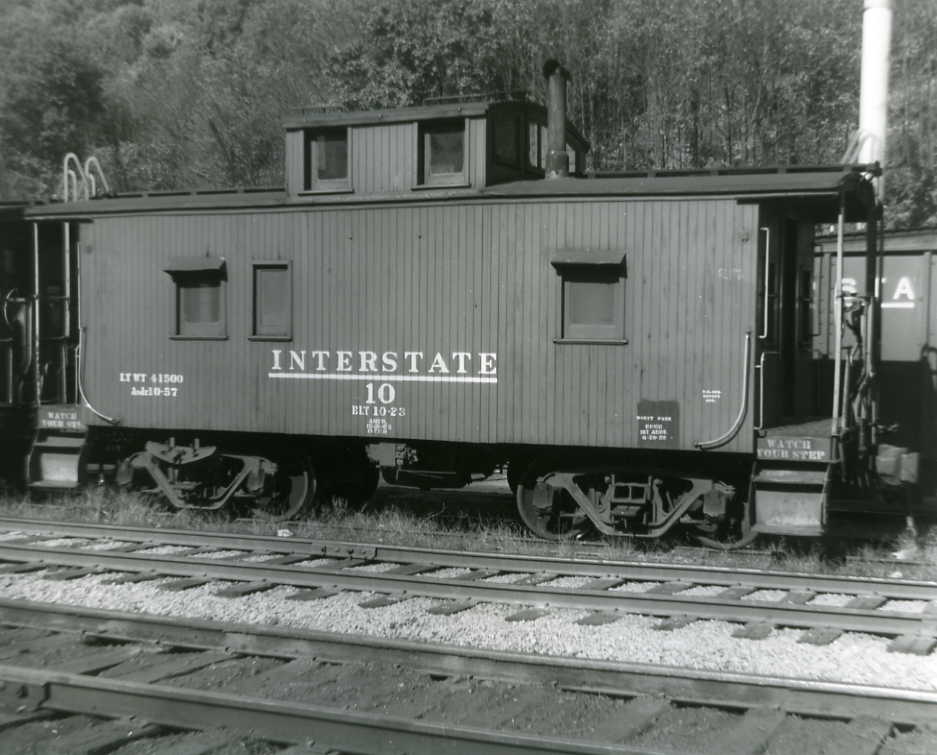
10.....Built 1923 for the Int. RR, retired in 1966.
11.....Built 1923 for the Int. RR, retired in 1973.
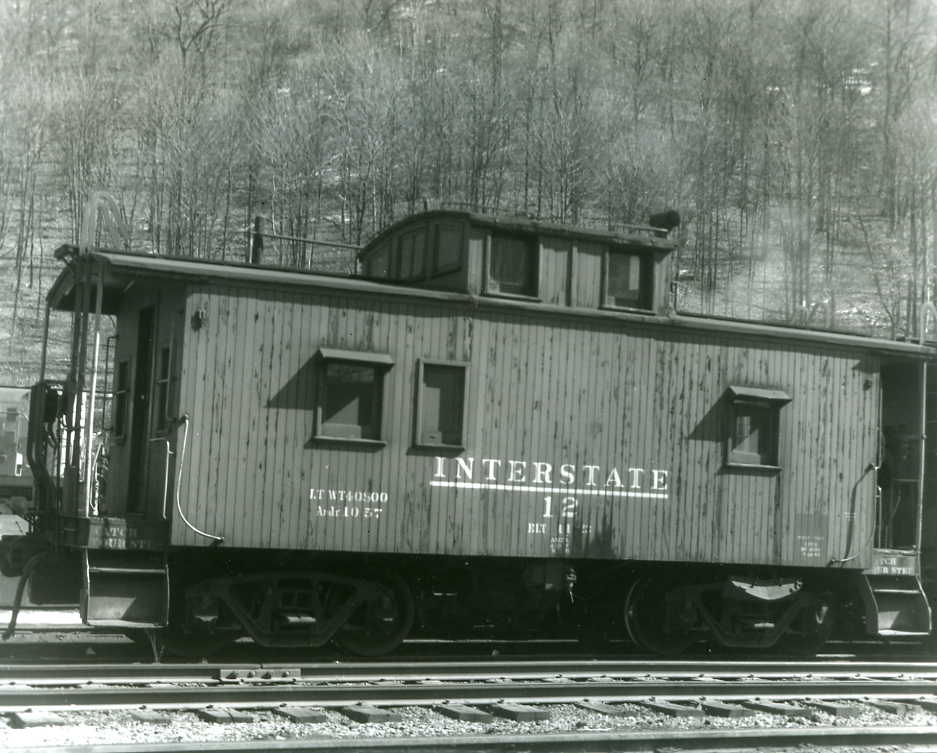
12.....Built 1923 for the Int. RR, retired in 1973.
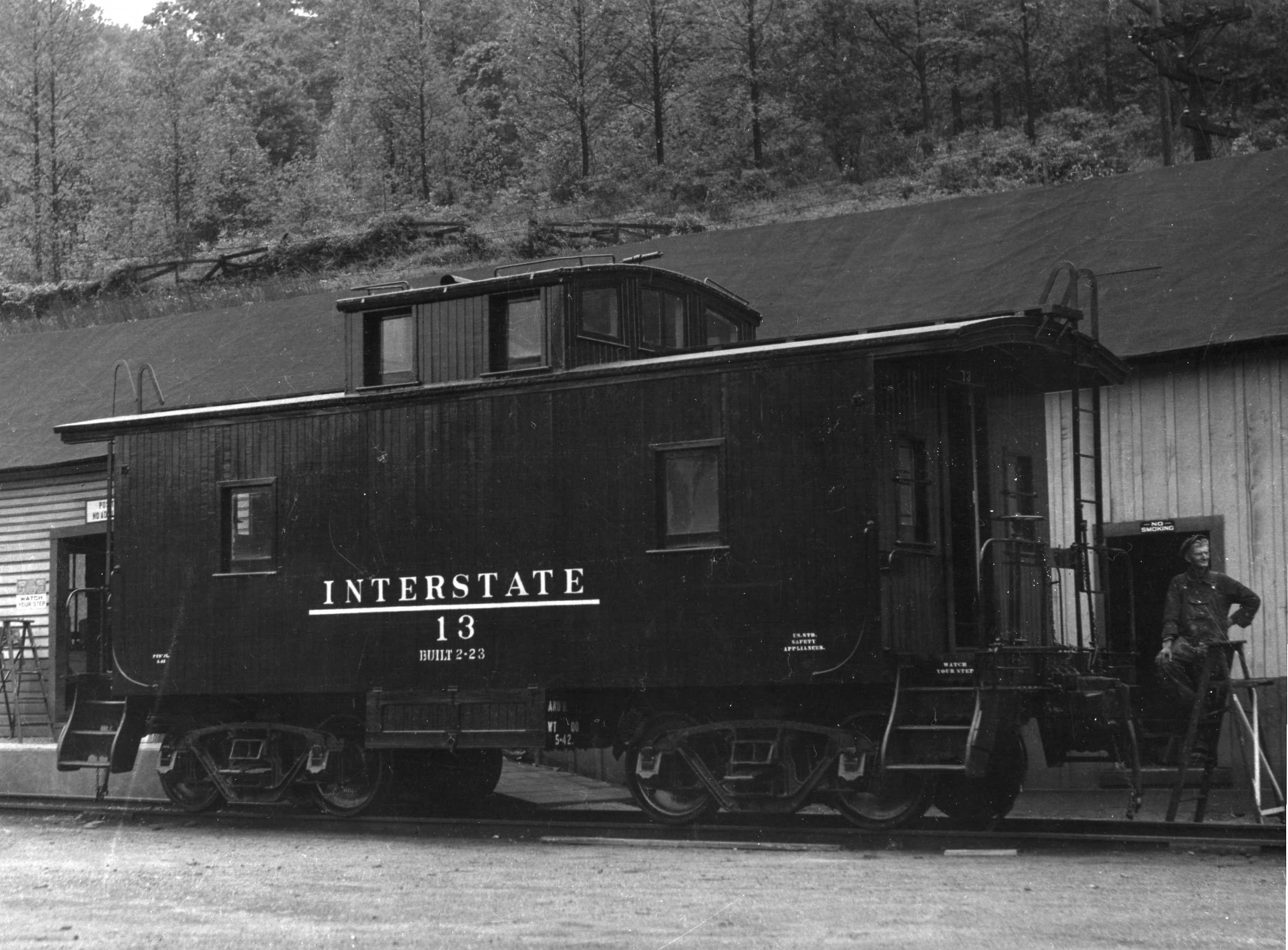
13.....Built 1923 for the Int. RR, retired in 1973.
14.....Built 1927 for the Int. RR, retired in 1973.
15.....Built 1927 for the Int. RR, retired in 1966.
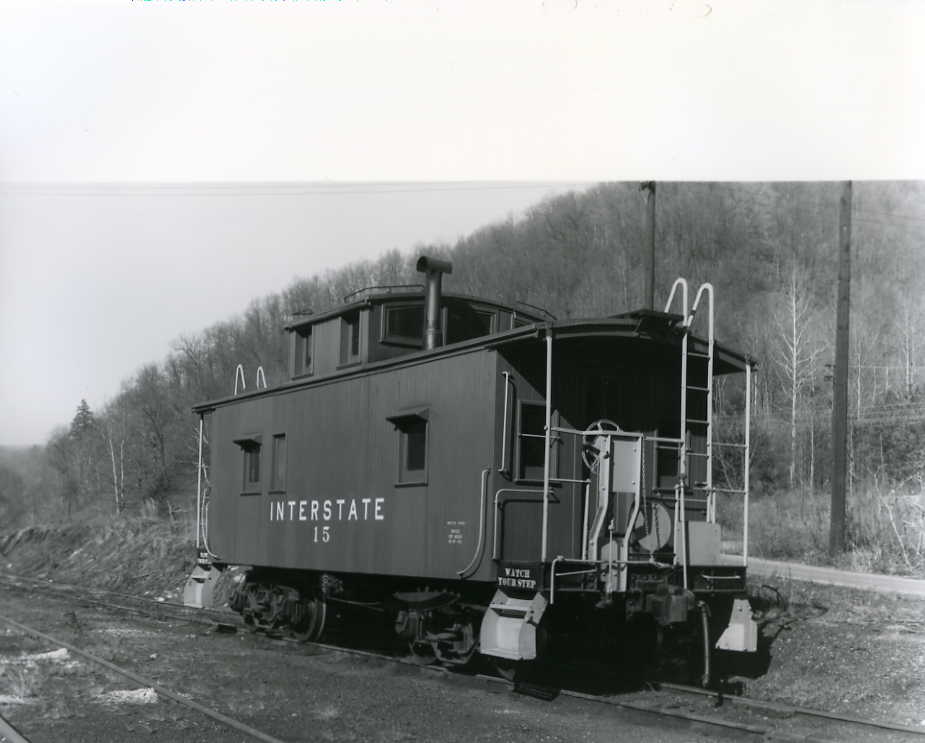
16.....Acquired in 1936, retired in 1973.
17.....Acquired in 1948, retired in 1956.
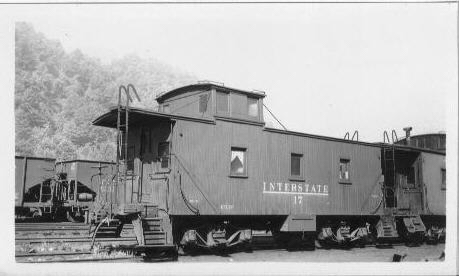
18.....Acquired in 1948, retired in 1957.
19.....Acquired in 1948, retired in 1964.
20.....Acquired in 1954, retired in 1964.
21.....Acquired in 1954, retired in 1973.
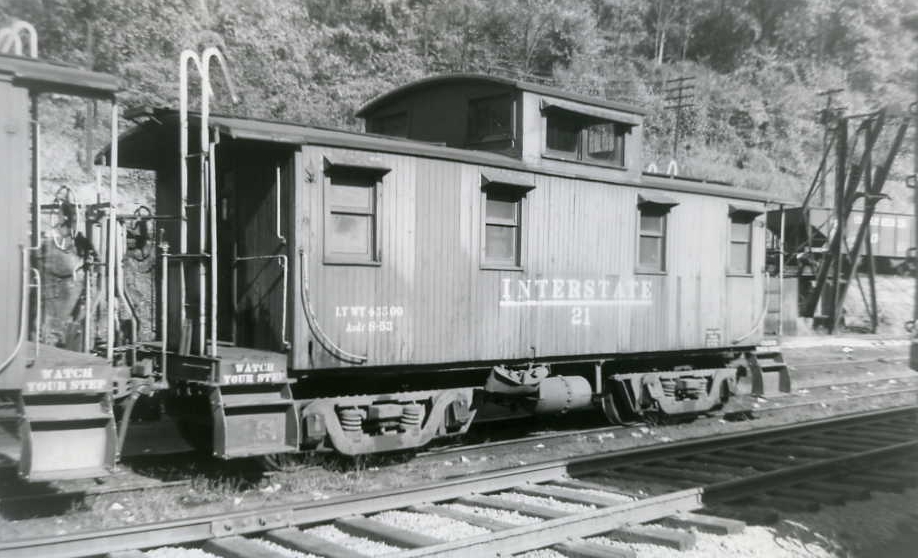
Cab #9 was built from an old Interstate boxcar .
Cab #10-13 had the centered cupola with 3 windows on the front and rear.
Cab#14-15 had the centered cupola.
Cab #16 was purchased from N&W, it had the centered cupola.
Cab #17 it had wooden sides and the cupola was offset to one end. (see photo page.) Don't know what RR it came from at this time.
Cab18-19 were purchased from Southern, they had wooden sides and the cupola was centered on the body. Number 18 was destroyed in an yard accident. It seems that it was sandwiched between a bunch of coal hoppers and crushed. The conductor was inside, but was warned just in time, and made his escape. No one was injured. ( Thanks to Ed Wolfe for this bit of information.)
Cab #20-21 were purchased from Lackawanna (#614 and 670). They arrived at Andover with Int. markings and numbered #614 and 670. They were soon repainted and renumbered.
All the cabs had a red body with a black roof and under frame. White lettering and yellow steps and railings. The newest Interstate book, volume 3, has a color photo of a couple of cabs in the 50's with different colors. One is a mineral red color with a black roof and the other is bright red. My guess on this is the mineral red color was an older caboose. The bright red one looks like it has just been painted. The Southern era brought a solid red caboose and later a red and yellow scheme. During the early to late 60's, Southern started painting some of the cabs in a mineral red color. But, it was back to red after a new pres. took over.
The Southern era saw the retirement of the orig. Interstate cabs and they were replaced by steel cupola cabooses. These came from other parts of the Southern System. These were used because of some clearance problems on the line.
X251.........Savannah & Atlanta home-built
X252.........Savannah & Atlanta home-built
X253.........Savannah & Atlanta home-built
X255.........ex-Reading, Savannah & Atlanta
X256.........ex-Reading, Savannah & Atlanta
X257.........ex-Norfolk Southern (the orig NS)**
All were retired in 1986.
**Note: This was the only Norfolk Southern caboose to be painted for Southern Railroad
and to see uses on the system.
Special thanks to Jerry M. LaBoda for the information about the Southern Steel Cupola Caboose. Please visit his Yahoo Group - RRCaboose for pictures of these cabooses. They are located under the files section, in the Southern Steel Cupola file.
Also, thanks to Ed Wolfe for the information about #18 and his books on this railroad. Most of the information on this page came from there.